PLAYABLE RECORD
STL FILES, EXPLAINED
Downloading a record STL and getting sound out of it are two very different things. Here's what separates a decorative disc from one a stylus can actually read.
The short answer
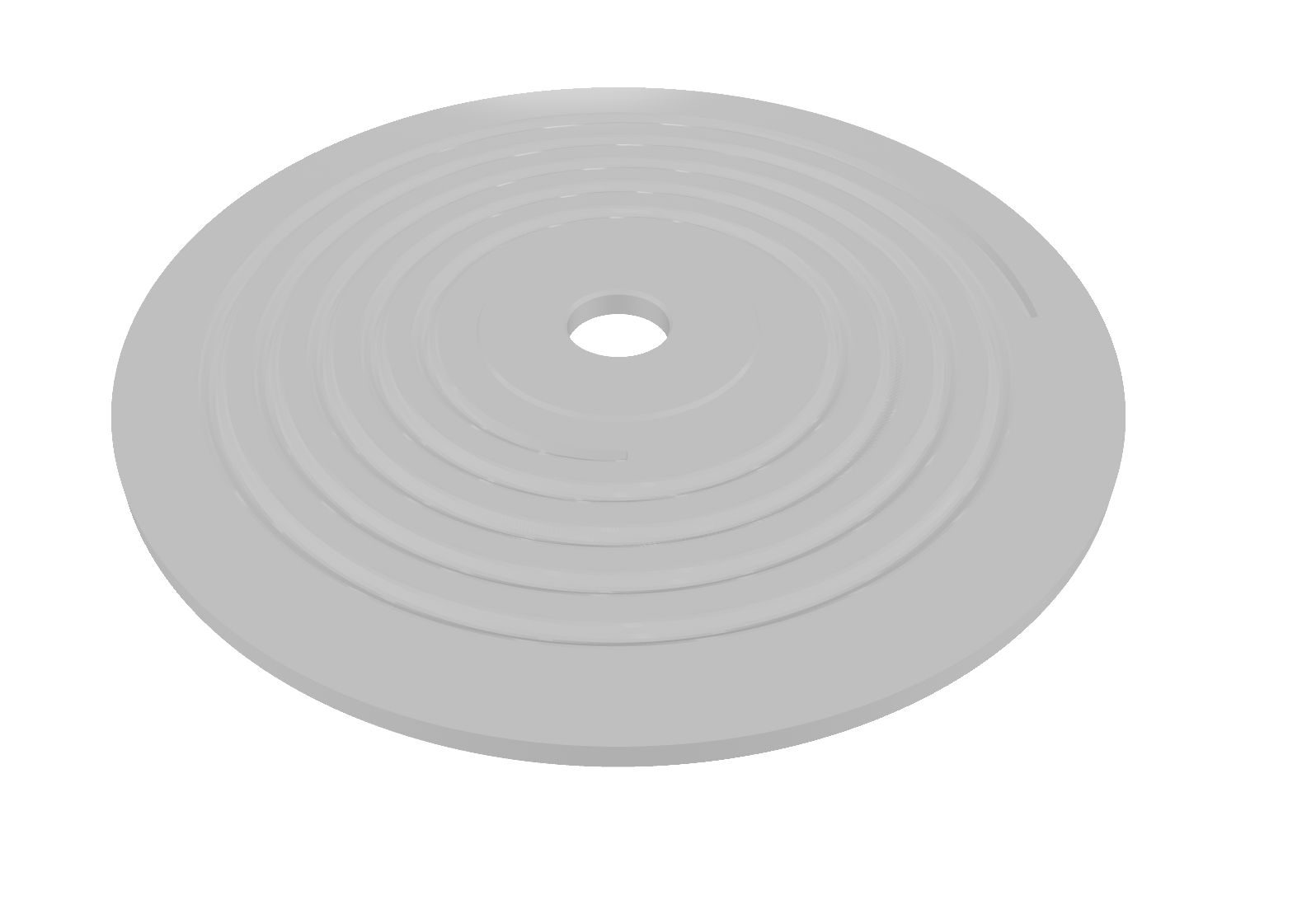
A playable record file is not a model of a record — it is a physical encoding of one specific audio track. That is why generic "record STL" downloads never play: there is no audio in them. The spiral has to be generated from the waveform, at a groove pitch and depth your printer can actually hold.
WHAT A REAL GROOVE FILE NEEDS
- Generated from a mono, band-limited master — not applied to a finished model afterwards.
- Groove pitch wide enough that adjacent walls do not merge at your printer's resolution.
- Groove depth and wall angle sized for a conical stylus tip, not a knife-edge V.
- A watertight, manifold mesh — a single flipped normal can make the slicer skip whole regions.
- A lead-in spiral and a locked run-out groove so the arm lands and parks correctly.
- A flat, unwarped base plane so the disc sits true on the platter.
STL VS 3MF
STL
- Universally supported by every slicer
- No units — scale errors are common
- Uncompressed; groove meshes get enormous
- Carries no print settings or licence data
3MF
- Compressed — far smaller for dense groove meshes
- Real units, so the disc is always correctly scaled
- Can embed print profiles and per-object settings
- Room for metadata such as licence and artist ID
Kräftsound ships 3MF for exactly these reasons: the file carries its own printer profile, and the licence token travels with the geometry rather than sitting in a separate agreement nobody reads.
COMMON QUESTIONS
Where can I download playable record STL files?
Model sites host plenty of record-shaped STLs, but almost all are decorative — the groove is either cosmetic or far too coarse to track. A playable file has to be generated from a specific audio track, so it cannot be a generic download.
Why doesn't STL work well for record grooves?
STL stores raw triangles with no units, no compression and no metadata. A groove spiral needs millions of tiny facets, so files balloon into hundreds of megabytes and slicers slow to a crawl or fail outright.
Is 3MF better than STL for printable records?
Yes. 3MF is compressed, carries real units, and can hold per-object print settings and metadata alongside the mesh — so the disc arrives with the right layer height and profile attached rather than relying on the user to guess.
Can I convert an audio file to STL myself?
Yes, with open-source groove generators, but you own the whole chain: band-limiting, groove pitch, mesh density, watertightness and licensing. Most failures come from a non-manifold mesh or a groove finer than the printer can resolve.
Related: the full print walkthrough.
Skip the groove maths
Kräftsound turns a track into a print-ready 3MF disc file — groove geometry, printer profiles and licensing handled for you.