Entry 43 · 26 November 2026 · 2 min read
The disc becomes the interface
- product
- in the app
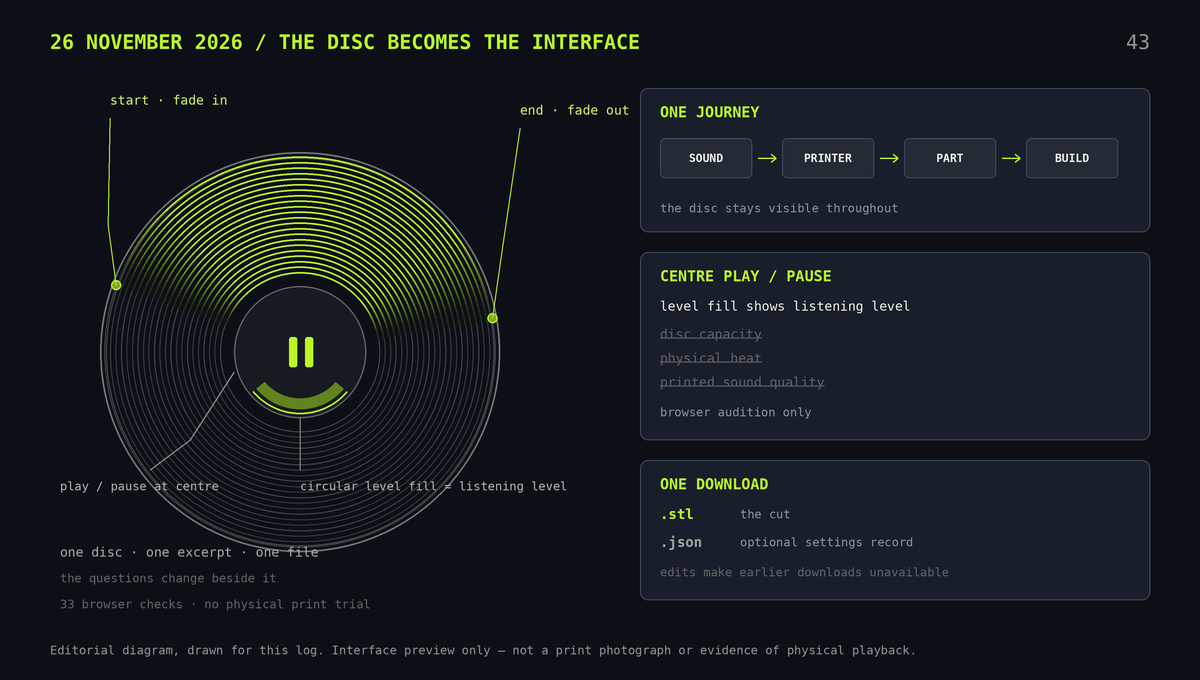
Today was about making the Studio easier to understand. There had been too many competing waveforms, listening controls and questions. We brought the experience back to one idea: the disc is the centre of the interface.
The journey now follows Sound → Printer → Part → Build. The disc stays visible throughout, while the questions change beside it. Printer setup asks for the process, preset, diameter and speed one at a time, so available playing time is established before choosing an excerpt.
Start, End, Fade in and Fade out are named on the circular view and appear in Part, where they are useful. Time fields sit directly above the disc. The green waveform shows the selected portion and its fades; optional sound polishing stays separate from creating the STL, with a compact round Room control.
Play and Pause sit at the centre of the disc. A circular audio-level fill rises from the bottom in brighter green as the audition level increases, then fades away when playback stops. It observes listening level—not disc capacity, physical heat or printed sound quality. The button and seconds remain readable above it.
Original and Cut share the same player. Cut is available only after a fresh successful creation. Quiet mechanical clicks accompany handle changes, with an off switch; they are interface sounds and never enter the exported cut.
When a printer setting changes capacity, the highlighted portion, End time and available-seconds display move together over four seconds. Reduced-motion mode updates immediately.
A suggested excerpt is not silently accepted for the disc. Listening previews that suggested window, and Use … s & continue confirms it explicitly. The original recording remains unchanged. On phones, the time fields stay close to the disc and the main continuation comes before optional extras.
We checked the complete signed-out journey with generated audio on desktop and phone-sized browsers, through printer selection, excerpt edits, creation and actual STL downloads. Both FDM and Form 4 paths were exercised. Each STL click downloaded one STL; the optional settings button downloaded a separate JSON record of the stored cut. Further edits made the previous downloads unavailable until a new cut was created. Permission confirmation was also checked.
Today's final flow review passed 33 focused regression checks. These are browser and software checks, not real-device touch tests or physical print trials.
Earlier today, we also added an opt-in Form 4 narrower-groove trial: 1.3 mm opening / 2.3 mm pitch, with the existing baseline still selectable. Digital capacity and mesh checks do not establish printability, tracking or sound fidelity. Ordinary printer-size restrictions remain; seven-inch Form 4 research still requires technician-reviewed orientation rather than an assumption of flat fit.
The interface work is preview-only and has not been published. Printed grooves remain experimental: rough surfaces may damage a stylus, cantilever or cartridge, and browser audition does not establish safe physical playback.
A good place to stop for today: one clearer journey, fewer competing controls, and the next physical questions kept honest.
This entry's particle study is decorative — not measured audio or a simulation of printed playback.