Entry 41 · 19 November 2026 · 2 min read
Keeping the music within reach
- technology
- measurement
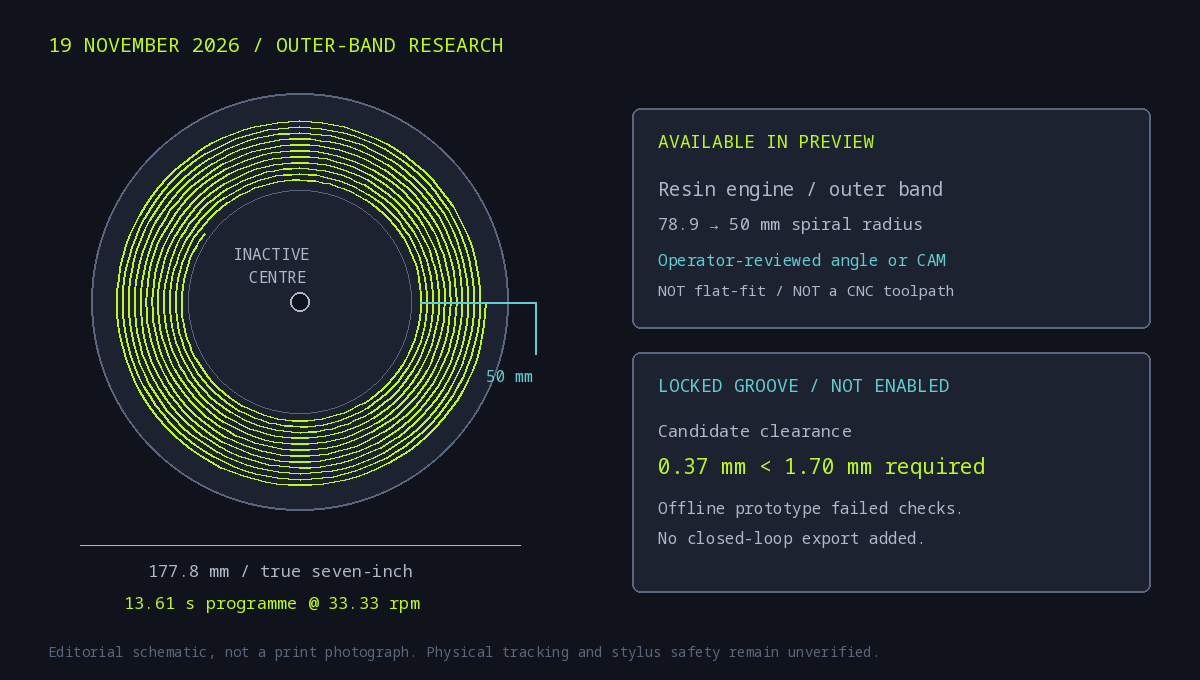
Today’s work started with practical feedback from a resin-print tester: the tonearms on two decks could not reach the inner part of the spiral. Switching to filament would open up larger sizes, but it would also use a different groove engine. The answer needed to stay with resin—and keep the music farther out.
A separate, explicitly acknowledged seven-inch research option is now available in the Studio preview. It creates a genuine 177.8 mm resin disc, with an outer-band spiral running from 78.9 mm to 50 mm radius and a larger inactive centre. The spindle opening stays unchanged. Making the label smaller would allow the spiral to travel farther inward, which would not solve the reach problem; the tester still needs to measure the minimum radius each deck can actually reach.
The smaller playing band means less time: 13.61 seconds of programme at 33.33 rpm, with the existing silent lead-in and run-out turns reserved separately. Short audio is not stretched. Groove width, spacing, depth and sideways audio movement are unchanged, so this experiment isolates the playing area rather than combining several changes.
Seven inches still cannot fit flat on the Form 4’s 200 × 125 mm plate. This research file is for technician-reviewed angled printing or separately prepared CNC work—not an approved print orientation or a CNC toolpath. The ordinary flat-fit restriction remains in place. A complete test cut produced one STL measuring 177.8 × 177.8 × 2.4 mm; the full inward spiral remains blocked because it would reduce mesh precision under the current budget.
We also explored a conventional silent locked groove: a circle that the stylus keeps following instead of travelling inward. The offline prototype closed smoothly, but its approach failed a clearance check: 0.37 mm where 1.70 mm was required. No locked-groove export was added. A closed groove would repeat indefinitely, not lift the stylus or guarantee safety.
Across the work, 1,220 main tests and 75 geometry tests passed. The proven 116 mm Form 4 baseline, corrected audio clock, separate detail test and single-STL-only download remain intact. Everything stays in preview; nothing was published.
Next comes operator review, tonearm measurements and a controlled physical trial. Digital checks do not establish printed sound quality or safe tracking, and rough resin grooves can damage the stylus or cartridge.
This entry's particle study is decorative — not measured audio or a simulation of printed playback.